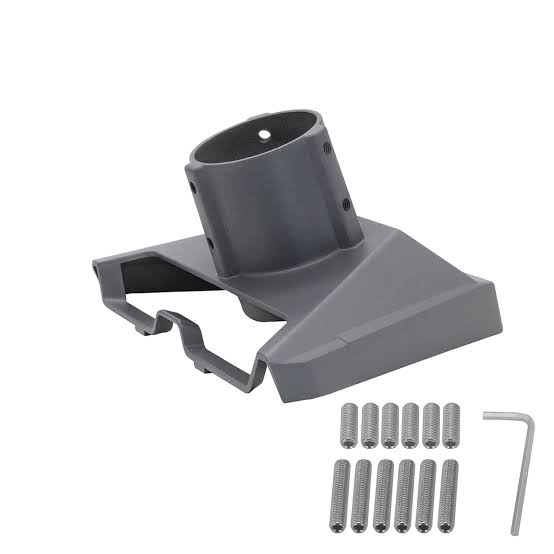
Starlink Standard Pipe Adapter
Buy Starlink Standard Pipe Adapter in Uganda for secure pole mounting, flexible positioning and durable Starlink installation. Order yours today.
Contact us for current pricing in Uganda
Contact us for current pricing in Uganda
Product Details
Starlink Standard Pipe Adapter: 7 Powerful Mounting Benefits
Starlink Standard Pipe Adapter in Uganda
A good Starlink installation depends heavily on location.
The terminal needs a sufficiently clear view of the sky to communicate with the satellite network. Trees, buildings, walls and other structures can interrupt that view.
In some properties, the easiest way to achieve additional elevation is by using an existing pole.
The Starlink Standard Pipe Adapter is specifically designed for this purpose.
Instead of installing a completely new Starlink mast, the adapter connects compatible Standard or Enterprise hardware to an appropriate existing pole.
This can provide a clean and practical installation where suitable infrastructure is already available.
What Is the Starlink Standard Pipe Adapter?
The Standard Pipe Adapter is a mounting accessory that creates an interface between compatible Starlink hardware and an existing pole.
The adapter attaches securely around the pole while providing the correct connection point for Starlink.
This makes it useful for properties that already have a structurally suitable pole in a location with good sky visibility.
Potential applications include:
-
Residential properties
-
Offices
-
Farms
-
Schools
-
Lodges
-
Hotels
-
Construction sites
-
Commercial properties
-
Remote facilities
The pole still needs to meet Starlink's published size and structural requirements.
Starlink Standard Pipe Adapter Specifications
Table 1: Standard Pipe Adapter Specifications
| Specification | Details |
|---|---|
| Product | Starlink Standard Pipe Adapter |
| Accessory Type | Pole mounting adapter |
| Primary Application | Existing pole installation |
| Compatibility | Starlink Standard and Enterprise |
| Supported Pole Diameter | Approx. 31–63.5 mm |
| Pole Diameter in Inches | Approx. 1.25–2.5 in |
| Adapter Height | Approx. 213 mm / 8.4 in |
| Maximum Width | Approx. 90 mm / 3.5 in |
| Package Weight | Approx. 0.97 kg / 2.14 lb |
| Pole Included | No |
| PVC/Plastic Pole Recommended | No |
| Installation Type | Permanent/semi-permanent |
The most important measurement is the pole diameter. Measure the intended pole before purchasing the adapter rather than assuming it will fit.
What Comes with the Standard Pipe Adapter?
The accessory includes the hardware required to attach compatible Starlink equipment to an appropriate pole.
Table 2: Standard Pipe Adapter Package Contents
| Component | Purpose |
|---|---|
| Pipe Adapter | Connects Starlink to existing pole |
| Mounting Hardware | Secures adapter around pole |
| Fastening Components | Tighten and stabilise installation |
| Cable Routing Clips | Help organise Starlink cable |
| Starlink Terminal | Not included |
| Existing Pole | Not included |
The pole itself is not supplied with the Pipe Adapter.
This is important when budgeting or planning the installation. If no suitable pole already exists, a new structurally appropriate pole will need to be installed separately.
Compatible with Starlink Standard
The Pipe Adapter is designed for current Starlink Standard hardware.
Customers may commonly refer to current Standard hardware as:
-
Starlink Gen 3
-
Starlink V4
-
Starlink Version 4
-
Standard Gen 3
-
Standard 4
-
Standard 4 X
Starlink's newer Standard terminal does not use the same mounting architecture as every previous Starlink generation.
This means customers should verify the exact terminal before purchasing an adapter.
A mount being labelled "Starlink compatible" does not automatically mean it fits every Starlink kit.
Compatible with Starlink Enterprise
The Standard Pipe Adapter is also designed for compatible Starlink Enterprise installations.
This can be useful for commercial properties where a suitable pole already exists.
Enterprise installations may combine Starlink with:
-
Third-party routers
-
Managed network switches
-
WiFi access points
-
CCTV networks
-
Structured Ethernet cabling
-
Backup internet connections
The Pipe Adapter only handles the physical terminal installation.
The rest of the business network should be planned according to the property's coverage, capacity and reliability requirements.
Supported Pole Diameter
Pole diameter is one of the most important compatibility requirements.
Table 3: Pipe Adapter Pole Compatibility
| Pole Diameter | Compatibility |
|---|---|
| Below 31 mm | Outside recommended range |
| 31 mm | Supported lower range |
| 40 mm | Within supported range |
| 50 mm | Within supported range |
| 60 mm | Within supported range |
| 63.5 mm | Supported upper range |
| Above 63.5 mm | Outside recommended range |
| PVC/Plastic Pipe | Not recommended |
The supported range of approximately 31–63.5 mm makes the adapter suitable for many common metal poles.
Always measure the outside diameter of the intended pole.
Do not estimate the measurement from photographs.
Why Pole Material Matters
A Starlink terminal mounted above ground can place mechanical forces on the supporting pole, especially during windy conditions.
The pole therefore needs sufficient structural strength.
Avoid using:
-
PVC pipe
-
Weak plastic tubing
-
Damaged poles
-
Heavily corroded poles
-
Thin decorative poles
-
Loose poles
A pipe may have the correct diameter but still be structurally unsuitable.
Diameter compatibility and structural strength are separate considerations.
Existing Pole Installation
The biggest advantage of the Standard Pipe Adapter is that it can reuse existing infrastructure.
A property may already have a suitable pole used for:
-
Previous internet equipment
-
Networking equipment
-
Communication equipment
-
Custom mounting systems
If that pole is structurally sound and located in a suitable position, the Pipe Adapter can provide a cleaner Starlink installation without adding another wall or roof mounting structure.
However, the existing pole should be inspected before installation.
Pole Height
The Pipe Adapter does not specify how tall the pole must be.
The correct height depends on the surrounding environment.
For example, a relatively short pole may work well in an open compound.
A property surrounded by walls or vegetation may require greater elevation.
The goal is not simply to install Starlink as high as possible.
The goal is to position it where it has a clear view of the sky while maintaining a structurally safe installation.
Check Starlink Obstructions First
Before attaching the Pipe Adapter, evaluate the intended location.
Potential obstructions include:
-
Trees
-
Buildings
-
Roofs
-
Water tanks
-
Utility poles
-
Chimneys
-
Solar panels
-
Other communication equipment
The Starlink App can help assess obstructions before permanent installation.
This should be done before investing time in modifying or installing a pole.
A strong pole in a heavily obstructed location is still a poor Starlink mounting position.
Standard Pipe Adapter Installation
Installation generally involves positioning the adapter on the top section of the selected pole and securing it according to the mounting instructions.
The terminal then connects to the adapter.
Before installation, verify:
-
Pole diameter.
-
Pole material.
-
Structural condition.
-
Pole stability.
-
Sky visibility.
-
Cable route.
-
Safe access.
Do not begin by simply attaching the Starlink hardware and dealing with these issues afterwards.
Make Sure the Pole Is Stable
The Pipe Adapter cannot compensate for an unstable pole.
Check the supporting structure.
A ground-installed pole should have an appropriate foundation.
A building-mounted pole should have secure structural attachment.
Movement at the base can translate into greater movement at the top.
A tall, flexible pole may sway substantially even if the Pipe Adapter itself remains tight.
Professional assessment may be worthwhile for high or exposed installations.
Cable Routing Along the Pole
Pole installations can provide a neat cable route.
The Starlink cable can travel down the pole toward the building or network equipment.
Cable-routing clips can help keep the installation organised.
Avoid leaving long sections of cable hanging freely.
Loose cable may:
-
Move in strong wind
-
Rub against metal
-
Catch on objects
-
Become damaged
-
Create an untidy installation
Cable routing should be planned before the terminal is installed.
Protect the Cable at Ground Level
Once the cable reaches the bottom of the pole, it may need to travel toward the building.
Protect the cable from:
-
Vehicles
-
Foot traffic
-
Animals
-
Lawn equipment
-
Construction equipment
-
Sharp objects
If the cable crosses an exposed area, appropriate protection should be considered.
Do not assume that because the terminal is safely elevated, the entire installation is protected.
Standard Pipe Adapter vs Wall Mount
The Pipe Adapter and Wall Mount provide different ways of elevating Starlink.
Table 4: Pipe Adapter vs Wall Mount
| Feature | Pipe Adapter | Wall Mount |
|---|---|---|
| Existing Pole Required | Yes | No |
| Exterior Wall Required | No | Yes |
| Pole Diameter Requirement | Yes | No |
| Elevated Installation | Yes | Yes |
| Building Drilling | Not always | Yes |
| Cable Route | Down pole | Down wall |
| Best Use | Existing suitable pole | Gable/fascia |
| Permanent Installation | Yes | Yes |
If a suitable pole already exists, the Pipe Adapter can be an efficient solution.
If no pole exists but the building has a suitable exterior wall, the Wall Mount may be easier.
Standard Pipe Adapter vs Pivot Mount
The Pivot Mount attaches Starlink directly to a suitable slanted roof.
Table 5: Pipe Adapter vs Pivot Mount
| Feature | Pipe Adapter | Pivot Mount |
|---|---|---|
| Existing Pole Required | Yes | No |
| Slanted Roof Required | No | Yes |
| Roof Penetration | No | Yes |
| Pole Installation | Yes | No |
| Adjustable Roof Geometry | Not applicable | Yes |
| Elevation | Depends on pole | Roof level |
| Best Application | Existing pole | Sloped roof |
| Cable Routing | Along pole | Across/down roof |
Where a pole already offers excellent sky visibility, there may be little reason to drill into the roof.
Where no pole exists, the Pivot Mount can provide a purpose-built roof installation.
Standard Pipe Adapter vs X-Frame Base
The X-Frame Base creates a freestanding ground installation.
Table 6: Pipe Adapter vs X-Frame Base
| Feature | Pipe Adapter | X-Frame Base |
|---|---|---|
| Existing Pole Required | Yes | No |
| Ground-Level Setup | No | Yes |
| Elevation | Potentially high | Limited |
| Portable | Limited | Better |
| Permanent Installation | Usually | Not necessarily |
| Good for Obstructions | Better with suitable height | Depends on open ground |
| Pole Included | No | Mast included |
| Best Use | Elevated fixed setup | Open-ground setup |
The X-Frame Base is convenient for temporary or ground-level installations.
The Pipe Adapter is more suitable where a permanent elevated pole position is available.
Standard Pipe Adapter for Homes
Residential properties may already have a suitable pole near the house.
Using the Pipe Adapter can position Starlink above:
-
Boundary walls
-
Vehicles
-
People
-
Garden vegetation
-
Low structures
The cable can then be routed down the pole and into the house toward Router 3.
WiFi coverage inside the property remains a separate consideration.
Large homes may need mesh routers or access points.
Standard Pipe Adapter for Offices
Businesses may use the Pipe Adapter to create a dedicated external Starlink position.
A typical office configuration could be:
Starlink Standard → Pipe Adapter → Starlink Cable → Router 3 → Network Switch → Office Network
From the switch, connectivity can be distributed to:
-
Computers
-
Printers
-
Access points
-
CCTV
-
VoIP phones
-
Other network equipment
The pole should be positioned so that the Starlink cable can reach the network location without unsafe routing.
Standard Pipe Adapter for Farms
Farms can be excellent environments for pole-mounted Starlink.
Large compounds may provide plenty of open sky, but trees and farm buildings can sometimes obstruct ground-level terminals.
A pole can raise Starlink above:
-
Fences
-
Crops
-
Farm equipment
-
Small structures
-
People and animals
The pole should be protected from vehicles and machinery.
If livestock have access to the area, cable protection also becomes important.
Standard Pipe Adapter for Lodges
Lodges and remote accommodation facilities may have large compounds with vegetation.
Pole mounting can provide flexibility in selecting a location away from buildings.
After Starlink reaches the network room, connectivity can be distributed through:
-
Ethernet
-
Managed switches
-
Access points
-
Compatible mesh systems
The Pipe Adapter itself does not increase WiFi range.
It only provides a suitable physical mounting interface for the Starlink terminal.
Standard Pipe Adapter for Schools
Schools can use pole-mounted Starlink to keep the terminal away from busy student areas.
A suitable pole can provide:
-
Elevation
-
Physical separation
-
Better sky visibility
-
Dedicated cable routing
The network can then serve classrooms, offices and computer laboratories through appropriately designed networking infrastructure.
Standard Pipe Adapter for Commercial Properties
Commercial properties may choose a pole installation when:
-
Roof access is difficult
-
Wall mounting is undesirable
-
A suitable pole already exists
-
Better elevation is needed
-
Cable routing is practical
The pole can be positioned independently of the main building, giving installers more freedom to find an unobstructed location.
This can be particularly useful on properties with complex roof designs.
Can You Use an Old Satellite Pole?
Possibly, but only after checking it carefully.
An old satellite or antenna pole may have a suitable diameter, but several factors matter:
-
Diameter
-
Corrosion
-
Wall thickness
-
Structural strength
-
Foundation
-
Attachment points
-
Position
-
Sky visibility
Do not assume that because a pole previously supported a television dish it is automatically suitable for Starlink.
The hardware and environmental loads may be different.
Can You Use a PVC Pole?
PVC and similar plastic pipes should not be used as structural Starlink mounting poles.
They may flex or fail under wind and mechanical loading.
Use a structurally appropriate pole that falls within the adapter's supported diameter range.
For exposed outdoor installations, corrosion resistance should also be considered.
Does the Pipe Adapter Increase Starlink Speed?
No.
The Pipe Adapter contains no electronics.
It does not increase:
-
Satellite bandwidth
-
WiFi coverage
-
Router power
-
Download speed
-
Upload speed
Its purpose is purely mechanical.
However, a pole can help position the terminal in a location with fewer obstructions.
If moving Starlink higher eliminates obstructions, the connection may become more consistent.
That improvement comes from better placement—not from the adapter amplifying the signal.
Wind Exposure
Elevation can improve satellite visibility, but it can also increase exposure to wind.
The higher the terminal is installed, the more important structural stability becomes.
Check:
-
Pole strength
-
Pole foundation
-
Building attachment
-
Adapter tightness
-
Corrosion
-
Excessive movement
Do not create an extremely tall improvised pole simply to gain elevation.
Engineering considerations become increasingly important as pole height increases.
Standard vs Standard Actuated Compatibility
Older Standard Actuated hardware uses a different mounting system from newer Standard hardware.
The current Standard terminal does not use the same self-orienting motor arrangement as Standard Actuated.
Customers replacing older hardware should therefore verify compatibility before reusing existing mounting components.
The existing pole itself may potentially remain useful if it meets the new adapter's requirements, but the old Starlink mounting adapter should not automatically be assumed compatible.
Standard Pipe Adapter vs Mini Pipe Adapter
These are different accessories.
Starlink Mini uses a Mini-specific mounting system.
The Standard Pipe Adapter is designed around compatible Standard and Enterprise hardware.
Do not purchase accessories based only on the word "Pipe Adapter."
Check the exact Starlink terminal first.
Choosing the Correct Pole Location
Before installation, consider three major factors:
1. Sky visibility
The terminal should have minimal obstruction.
2. Structural strength
The pole must securely support the hardware.
3. Cable route
The cable needs a safe route from Starlink to the networking equipment.
A location that satisfies only one or two of these requirements may still be unsuitable.
Professional Pole Installation
A simple existing pole may make installation straightforward.
However, new poles and high-level installations can require professional work.
A professional installer can assist with:
-
Site survey
-
Obstruction checking
-
Pole selection
-
Pole diameter verification
-
Structural assessment
-
Pipe Adapter installation
-
Terminal positioning
-
Cable routing
-
Router installation
-
Network configuration
Where a new tall pole is required, the foundation and wind loading deserve particular attention.
Why Choose the Starlink Standard Pipe Adapter?
The Starlink Standard Pipe Adapter is useful when you need:
-
Installation on an existing pole
-
Additional elevation
-
Standard compatibility
-
Enterprise compatibility
-
Support for approximately 31–63.5 mm poles
-
A permanent mounting solution
-
Cleaner cable routing
-
An alternative to drilling a roof
-
An alternative to wall mounting
-
Better positioning flexibility
It is especially valuable when a suitable pole is already available in a location with a clear view of the sky.
Why Buy from Starlink Uganda Installers?
Starlink Uganda Installers can help verify whether an existing pole is suitable before the Standard Pipe Adapter is installed.
Important considerations include pole diameter, material, structural condition, height, location and satellite visibility.
Where no suitable pole exists, installation assistance can include determining whether a new pole, Wall Mount, Pivot Mount or X-Frame Base would provide a better solution.
Professional assistance can also cover cable routing, Router 3 setup, Ethernet networking, WiFi distribution and complete Starlink installation.
Frequently Asked Questions About Starlink Standard Pipe Adapter
1. What is the Starlink Standard Pipe Adapter?
The Starlink Standard Pipe Adapter is a mounting accessory that allows compatible Starlink Standard or Enterprise hardware to be installed on an appropriate existing pole. It provides a secure interface between the Starlink terminal and the supporting pole.
2. Which Starlink kits are compatible with the Standard Pipe Adapter?
The current Standard Pipe Adapter is designed for Starlink Standard and Starlink Enterprise. Customers using Mini, Standard Actuated or other Starlink hardware should use accessories designed for their specific terminal.
3. What pole diameter does the Standard Pipe Adapter support?
The Standard Pipe Adapter supports poles approximately 31–63.5 mm (1.25–2.5 inches) in diameter. Measure the outside diameter of the pole before ordering.
4. Can I install the Standard Pipe Adapter on a PVC pole?
PVC and other plastic pipes are not recommended as structural mounting poles. A strong, structurally suitable pole should be used to safely support Starlink in outdoor conditions.
5. Does the Starlink Standard Pipe Adapter include the pole?
No. The Pipe Adapter is intended to attach to an existing suitable pole. If no suitable pole is available, one must be sourced and installed separately.
6. How tall is the Starlink Standard Pipe Adapter?
The adapter itself measures approximately 213 mm (8.4 inches) high, with an approximate maximum width of around 90 mm. The final terminal height depends primarily on the supporting pole.
7. How much does the Standard Pipe Adapter weigh?
The packaged Standard Pipe Adapter weighs approximately 0.97 kg (2.14 lb). Actual installed weight will also include the Starlink terminal and supporting structure.
8. Can I use an existing antenna or satellite pole?
Potentially. The pole needs to fall within the supported diameter range and must be structurally sound, stable and located where Starlink has a suitable view of the sky.
9. Is the Standard Pipe Adapter better than the Wall Mount?
It depends on the property. The Pipe Adapter is practical when a suitable pole already exists. The Wall Mount is better where an exterior gable or fascia provides the preferred installation location and no suitable pole is available.
10. Where can I buy a Starlink Standard Pipe Adapter in Uganda?
Customers can contact Starlink Uganda Installers for the Standard Pipe Adapter and assistance with pole compatibility checks, installation, terminal positioning, cable routing and complete Starlink setup.
Conclusion
The Starlink Standard Pipe Adapter provides a practical way to install compatible Starlink Standard and Enterprise hardware on an existing pole. With support for poles approximately 31–63.5 mm in diameter, it can create an elevated installation without requiring a dedicated Wall Mount, Pivot Mount or ground stand. The adapter is particularly useful where an existing structurally sound metal pole already provides good satellite visibility.
Choosing the correct pole is just as important as choosing the adapter. The pole needs the correct diameter, adequate structural strength and a secure foundation or attachment. PVC and weak plastic pipes should not be used as structural Starlink supports. Installers should also consider wind exposure, cable routing, working height and potential satellite obstructions before mounting the terminal. Where an existing pole is unsuitable, installing a proper new pole or selecting another Starlink mount may provide a safer and more reliable solution.
For a Starlink Standard Pipe Adapter in Uganda, Starlink Uganda Installers can assist with mount selection, pole assessment, professional installation, terminal positioning, cable routing, Router 3 setup and complete Starlink networking for homes, offices, farms, schools, lodges and commercial properties.